In a recent Substack post, Mark Locki showed that Calgary’s August 2024 blanket rezoning was enabling small infill projects to access CMHC’s MLI Select program, a federal mortgage insurance program that, in exchange for favourable financing, requires a portion of units to be rented at affordable rates. His analysis found that 39% of all 4-8 unit building permits in Calgary’s established communities were backed by MLI Select financing.
Edmonton’s Zoning Bylaw Renewal (ZBR), which came into force in January 2024, works through the same mechanism. And thanks to data I obtained through an Access to Information and Privacy (ATIP) request, we can now take a good guess at quantifying the interaction between ZBR and MLI Select.
tl;dr: Edmonton’s ZBR has already generated an estimated 480 mandated-affordable units through MLI Select financing, units that would not exist without rezoning.
Note
I am going off my own understanding of MLI Select, but I am not super familiar with the program. Please let me know if I got anything wrong that needs correcting.
What is MLI Select?
CMHC’s MLI Select program provides favourable mortgage insurance to rental housing developers in exchange for commitments to affordability, energy efficiency, and accessibility. Crucially for small infill projects, it allows developers to borrow up to 95% of project costs, dramatically reducing the equity required upfront.
The financing incentives are significant: a developer at Level 3 can borrow 95% of costs over 50 years, compared to 85% over 40 years at Level 1. This is why the vast majority of projects in the Edmonton data choose Level 3, committing to 25% affordable units in exchange for the program’s best terms.
The affordability threshold is 30% of median renter household income was approximately $1,500 per month for Edmonton’s CMA in 2021, based on a median renter household income of around $60,000 (Statistics Canada 2022a).1
I’ve been told by someone in the know that MLI Select’s approval generally comes just before or just after you get a permit.
Edmonton’s housing need
Edmonton had 46,155 households in core housing need as of the 2021 Census, a figure that has only grown as rents have risen since then (Statistics Canada 2022b).2 The city has been building more housing than almost anywhere else in Canada, but affordability remains a serious challenge: more homes help, but below-market rental units matter too.
MLI Select is one of the few tools that generates both at once. By tying favourable mortgage insurance to affordability commitments, it turns market-rate development into a vehicle for mandated-affordable housing and Edmonton’s rezoning has made it accessible to a new class of projects.
MLI Select in Edmonton: the overall picture
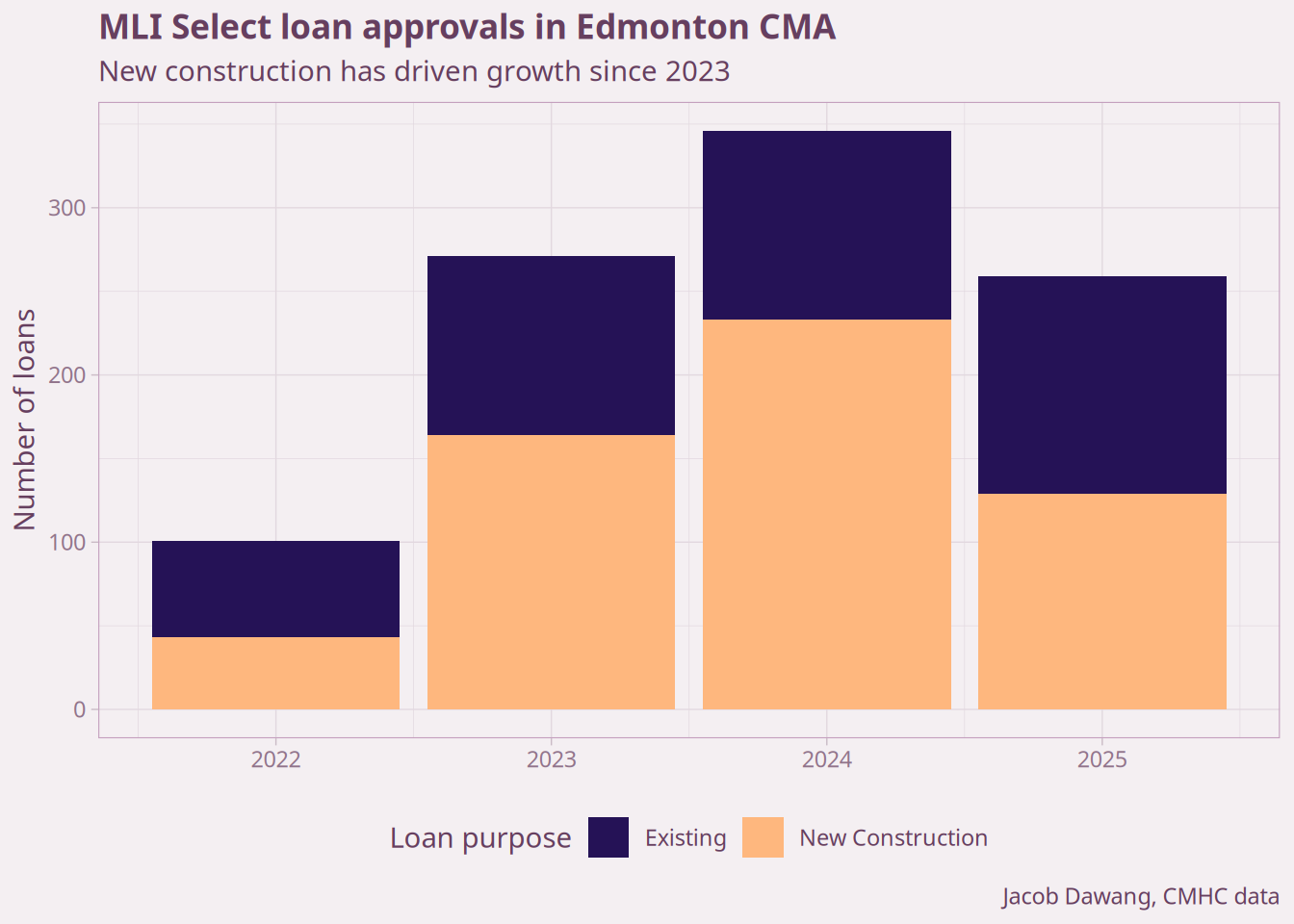
Between 2022 and 2025, CMHC approved 977 MLI Select loans in the Edmonton CMA, covering 33,388 units. The majority were for new construction.
As shown in Figure 1, new construction approvals peaked at 233 loans in 2024, before easing in 2025. This does not mean activity is declining. MLI approval precedes building permits, so 2025 permits largely reflect 2024 MLI approvals.
The ZBR connection: small infill projects
The real story is in small projects, the 5 to 8 unit rowhomes that ZBR specifically enabled in Edmonton’s mature neighbourhoods.
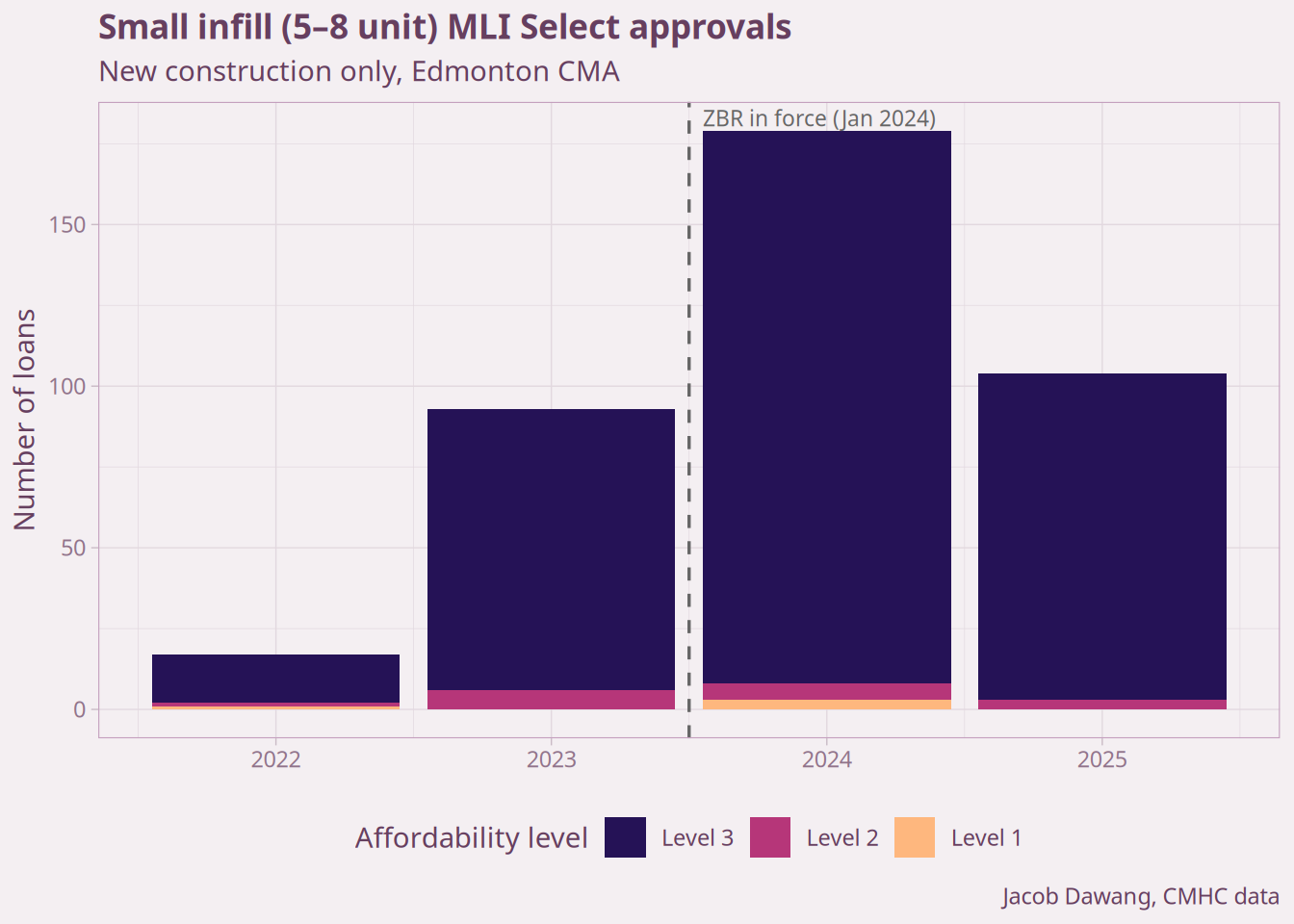
Figure 2 shows the numbers are striking:
- Pre-ZBR (2022–2023): 110 small new construction MLI Select loans in total
- Post-ZBR (2024–2025): 283 loans, 2.6 times more in just two years
In 2024 alone, developers secured 179 small infill MLI loans. This was the year ZBR came into force, opening up RS-zoned lots in mature neighbourhoods to 5-8 unit development. Developers, now confident their projects were permitted as-of-right, lined up federal financing.
Those 2024 MLI approvals fed directly into Edmonton’s 2025 building permit year, the first year more homes were permitted in 5–8 unit rowhomes than single family homes in the city’s history.
How many of Edmonton’s new rowhomes use MLI Select?
We can cross-reference the MLI Select approvals with Edmonton building permit data to estimate the share of small rowhome projects using MLI financing.
Across 2024 and 2025, Edmonton issued building permits for approximately 789 new 5–8 unit projects. Over the same period, roughly 36% of new small rowhome projects were backed by MLI Select financing, comparable to Mark Locki’s finding of 39% for Calgary.
This is necessarily an approximation: the MLI data covers the Edmonton CMA (including surrounding municipalities) while building permits cover Edmonton city only, and the lag between MLI approval and permit issuance varies by project.
Estimating affordable units created
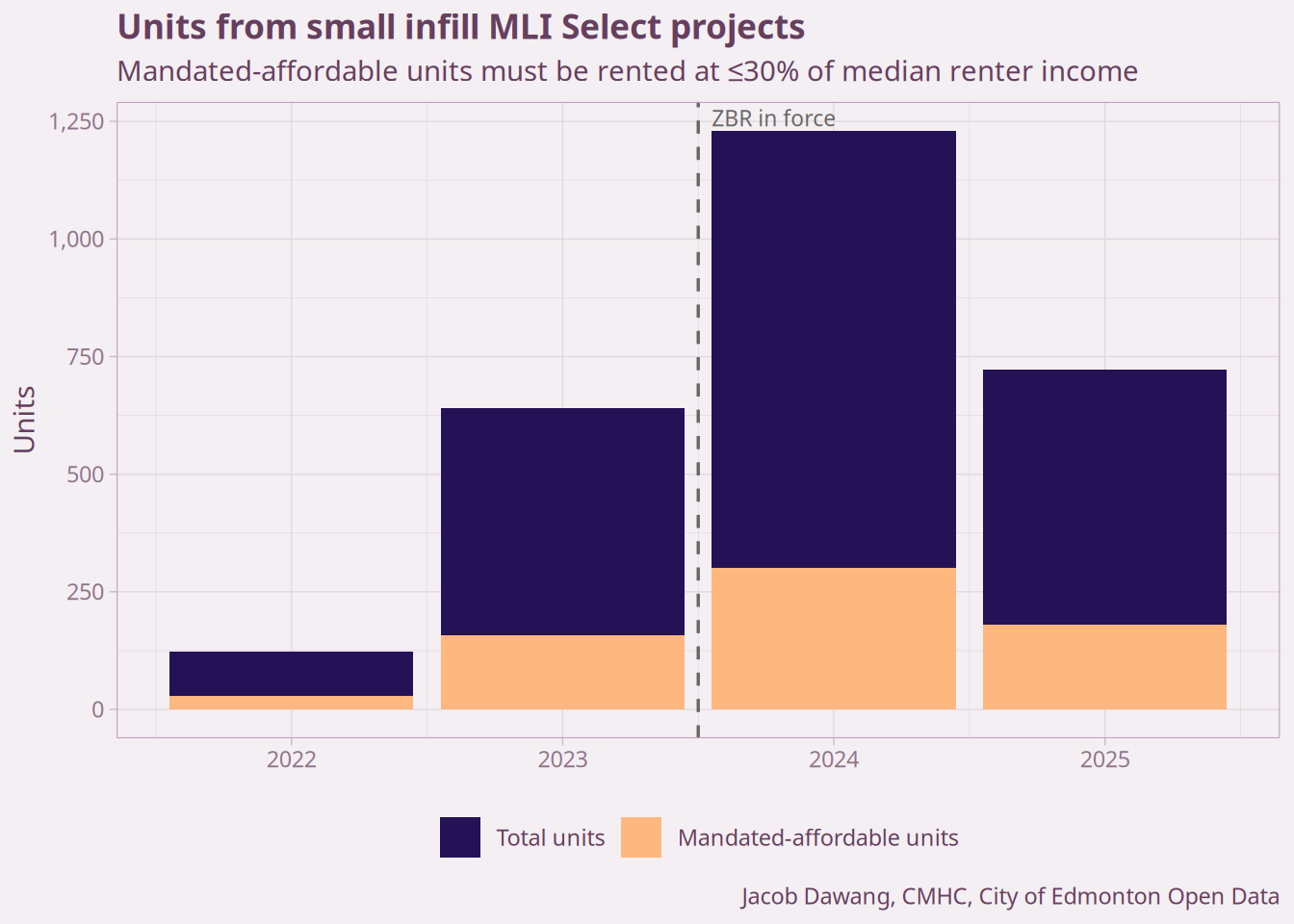
The most important implication of MLI Select’s prevalence among small infill projects is the mandated affordable units it generates. Across all four years, small infill MLI Select projects generated an estimated 666 mandated-affordable units in the Edmonton CMA, with approximately 480 coming in the ZBR era (2024–2025), a period that also saw 2.6 times as many projects as the two years prior (see Figure 3 and Table 1).
These are units where rents are contractually capped at roughly $1,500 per month or below.
| Estimated affordable units from small infill MLI Select, by year | ||||
| Year | MLI Select loans | Total units | Est. affordable units | Affordable share |
|---|---|---|---|---|
| 2022 | 17 | 122 | 29 | 24% |
| 2023 | 93 | 640 | 157 | 25% |
| 2024 | 179 | 1,230 | 301 | 24% |
| 2025 | 104 | 723 | 179 | 25% |
| Total | 393 | 2,715 | 666 | 25% |
| Jacob Dawang, CMHC, City of Edmonton Open Data | ||||
Conclusion
Small infill is only one part of Edmonton’s MLI Select story, but it is uniquely enabled by zoning. Large apartment towers were already generally permitted in the areas that they are today before ZBR. The 5-8 unit rowhomes could not exist in mature neighbourhoods until January 2024. A lot of the 283 small new construction MLI Select loans approved since ZBR represents a project that would have been illegal two years earlier.
Edmonton’s Zoning Bylaw Renewal is delivering on housing affordability in multiple ways. By legalizing small infill development in mature neighbourhoods, the ZBR didn’t just add housing supply, it unlocked CMHC’s MLI Select program for a class of projects that previously couldn’t exist. Those projects come with mandated affordable rents attached.
This is what good housing policy looks like: a municipal zoning reform enabling federal affordable housing finance, delivering affordable homes in mature neighbourhoods with established street grids, amenities, and transit connections where demand is high.
References
Statistics Canada. 2022a. Census Profile, 2021 Census of Population. Statistics Canada.
Statistics Canada. 2022b. Core Housing Need, 2021 Census of Population. Statistics Canada.