2025 was a banner year for Edmonton housing. We permitted over 17,500 homes, a record, found the missing middle, and built closer to transit than ever before. The question now is whether 2026 will continue that momentum, or whether 2025 was a one-time peak.
With Q1 2026 data in hand, we can take a first look. In the rest of this post, I compare Q1 2026 permits year-over-year against prior Q1s, project what a full 2026 might look like if this pace holds, look at which neighbourhoods are seeing the most RS Zone infill, and check whether Edmonton is continuing to build close to transit.
Key facts
Edmonton issued building permits for 2,844 homes in Q1 2026. Annualized, that projects to roughly 13,082 homes for the full year.
Q1 2026 is 13.2% lower than Q1 2025, when 3,277 homes were permitted.
Fiveplex to Eightplex projects led all categories by homes added in Q1 2026.
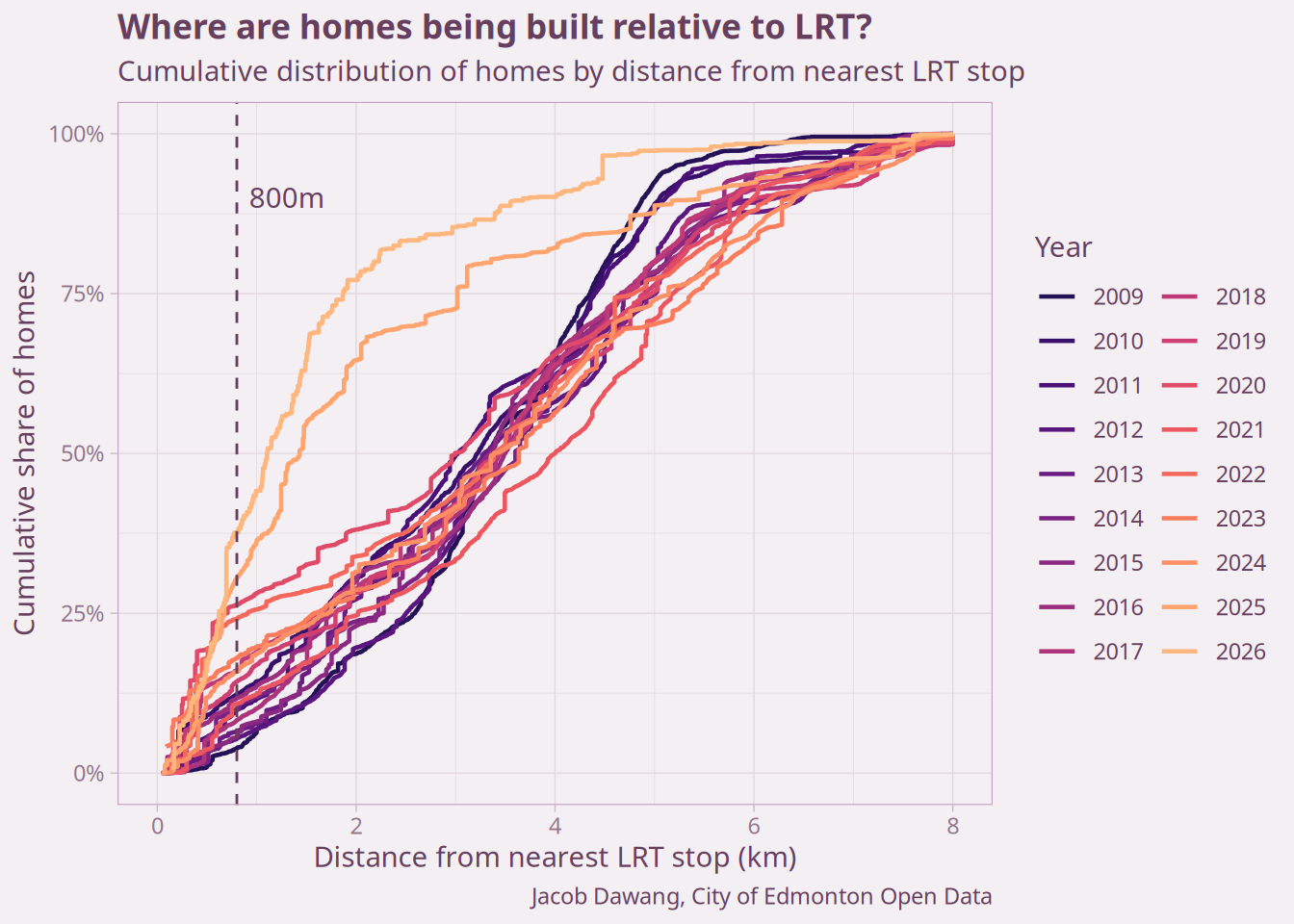
38% of homes were permitted within 800m of an existing or under-construction LRT stop, compared to 30% in 2025 (full year).
Data
Edmonton’s general building permit data tracks building permits since 2009, with columns for building type, work type, location, units added, and more. The 2026 data was downloaded on April 14, 2026, and filtered to Q1 (January through March) to exclude incomplete April data.
Edmonton’s property assessment data provides one row per property with zoning and neighbourhood information, used to calculate how many RS-zoned properties exist per neighbourhood.
For background on the RS Zone and ZBR, see the two-year review post.
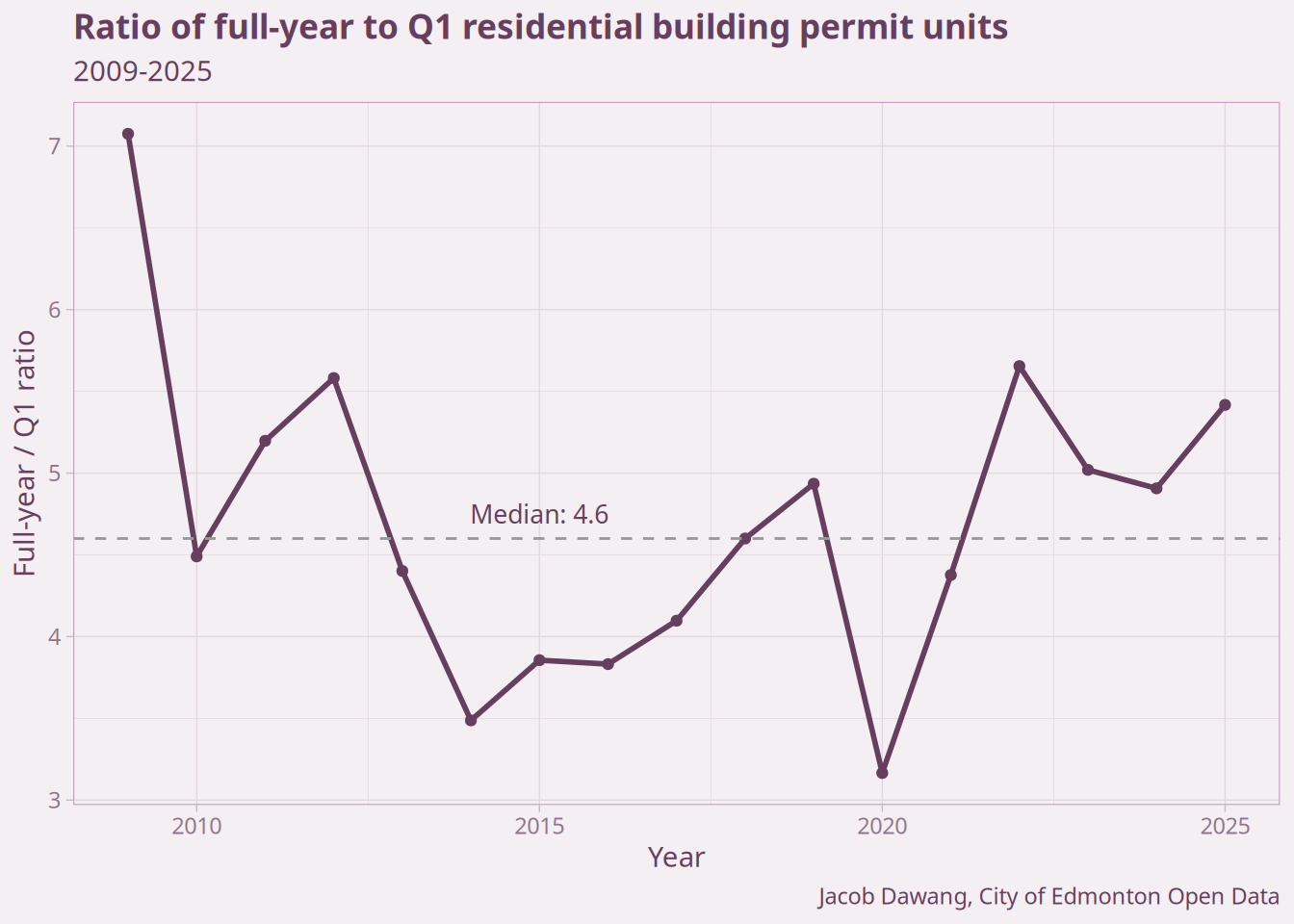
I want to project 2026 total numbers, but we only have Q1 data so far. Similar to my previous post in mid-2025, I estimate an annualization multiplier from historical data. For each year from 2009 to 2025, I calculate the ratio of full-year units to Q1 units, and use the median as the multiplier. Any figure that shows 2026 projected numbers uses this simple adjustment.
The median Q1 multiplier is 4.6×, as shown in Figure 1, meaning a full year typically produces 4.6 times the homes permitted in Q1 alone. All 2026 projections in this post use this multiplier.
Year-over-year Q1 comparison
The most direct way to compare Q1 2026 to prior years is to look at Q1 data across all years, stripping out seasonality entirely. Figure 2 shows units added in Q1 for each year since 2009, broken down by project type. 2026 is off to a strong start, with a steady number of homes permitted in Q1. Similar to 2025, we continue to see steady growth of the 5-8 unit category, which is firmly established as an important part of Edmonton’s housing supply.
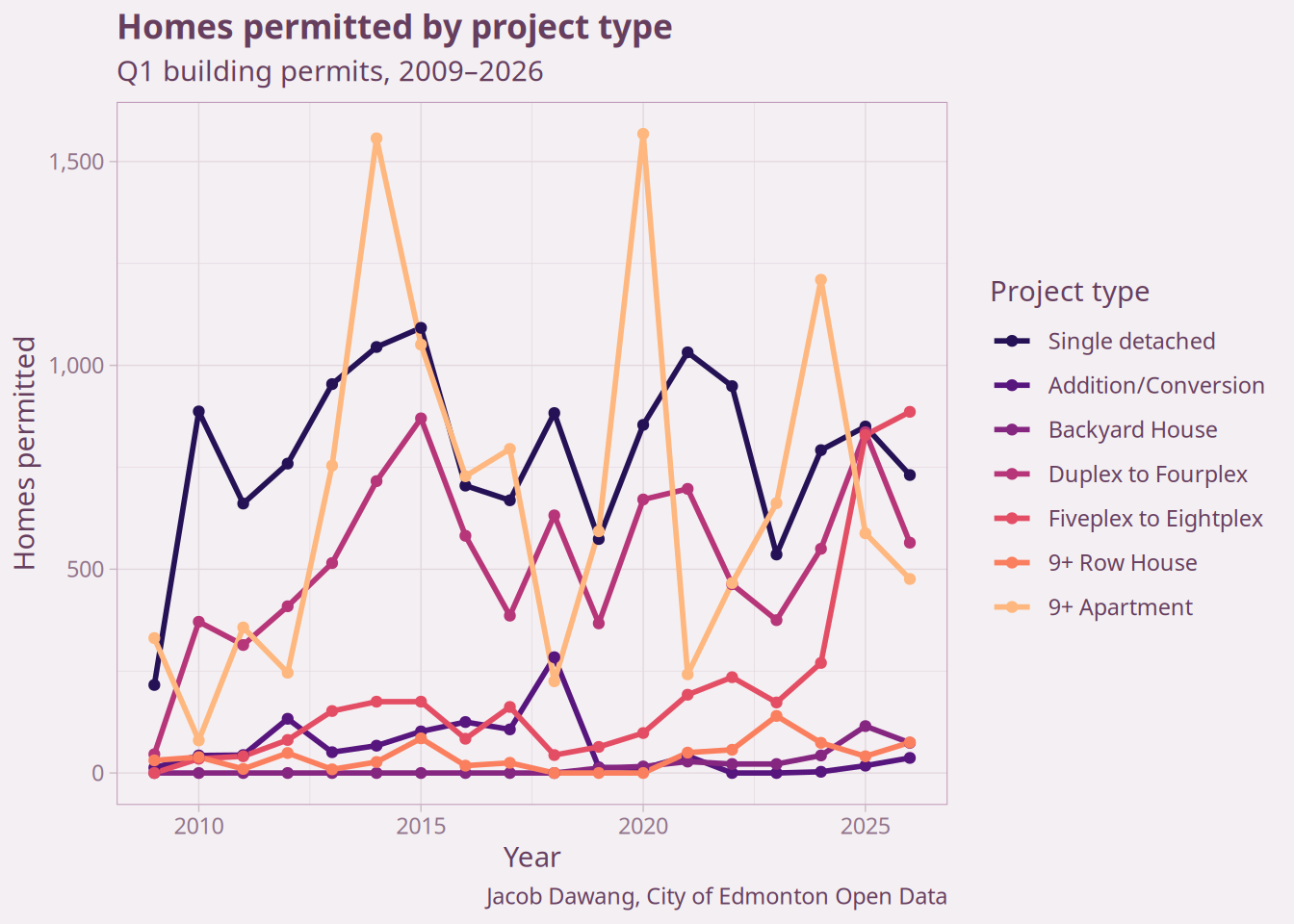
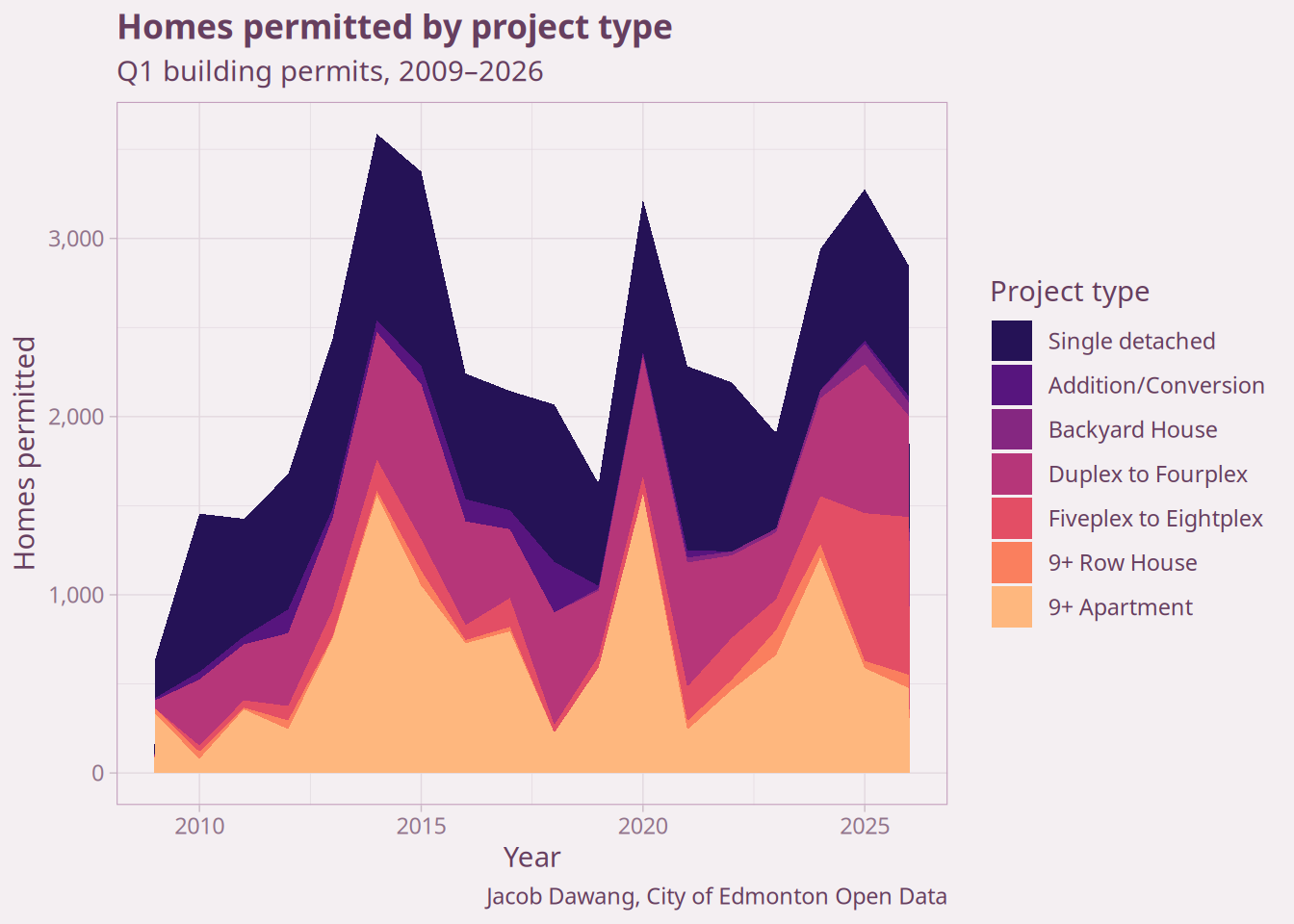
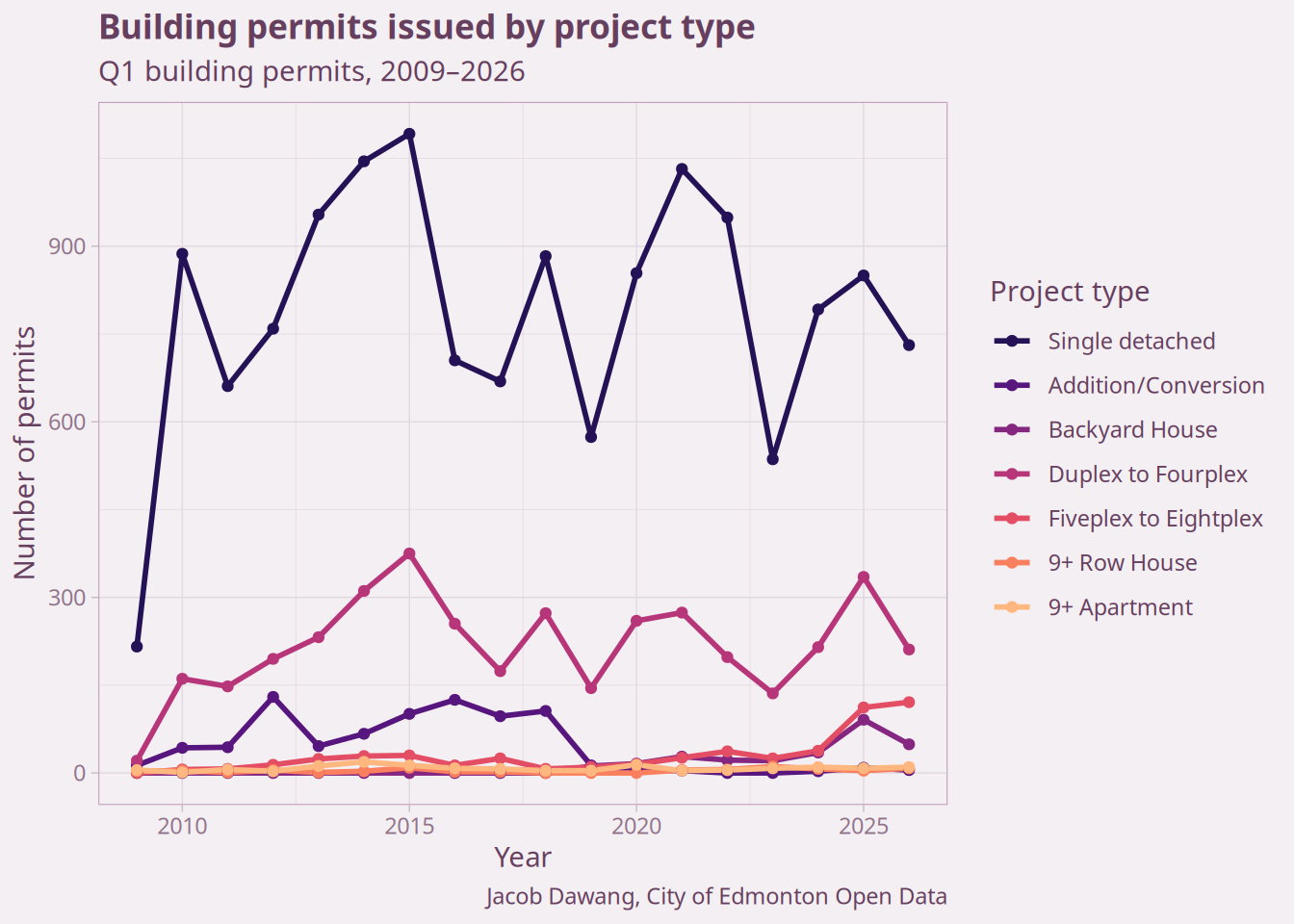
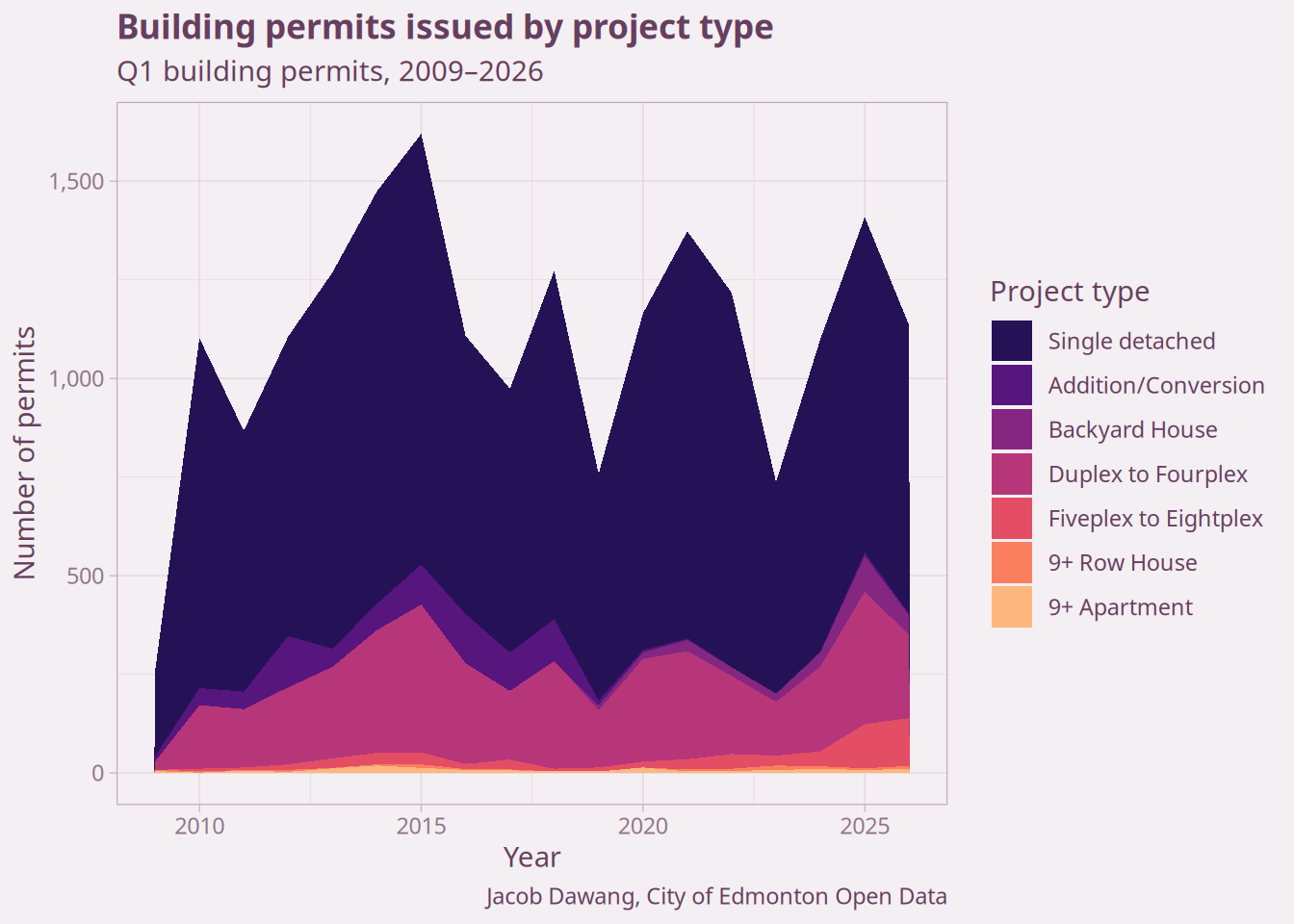
Figure 3 shows the same Q1 data as raw permit counts rather than units, a complementary view for understanding how many discrete projects are driving each category.
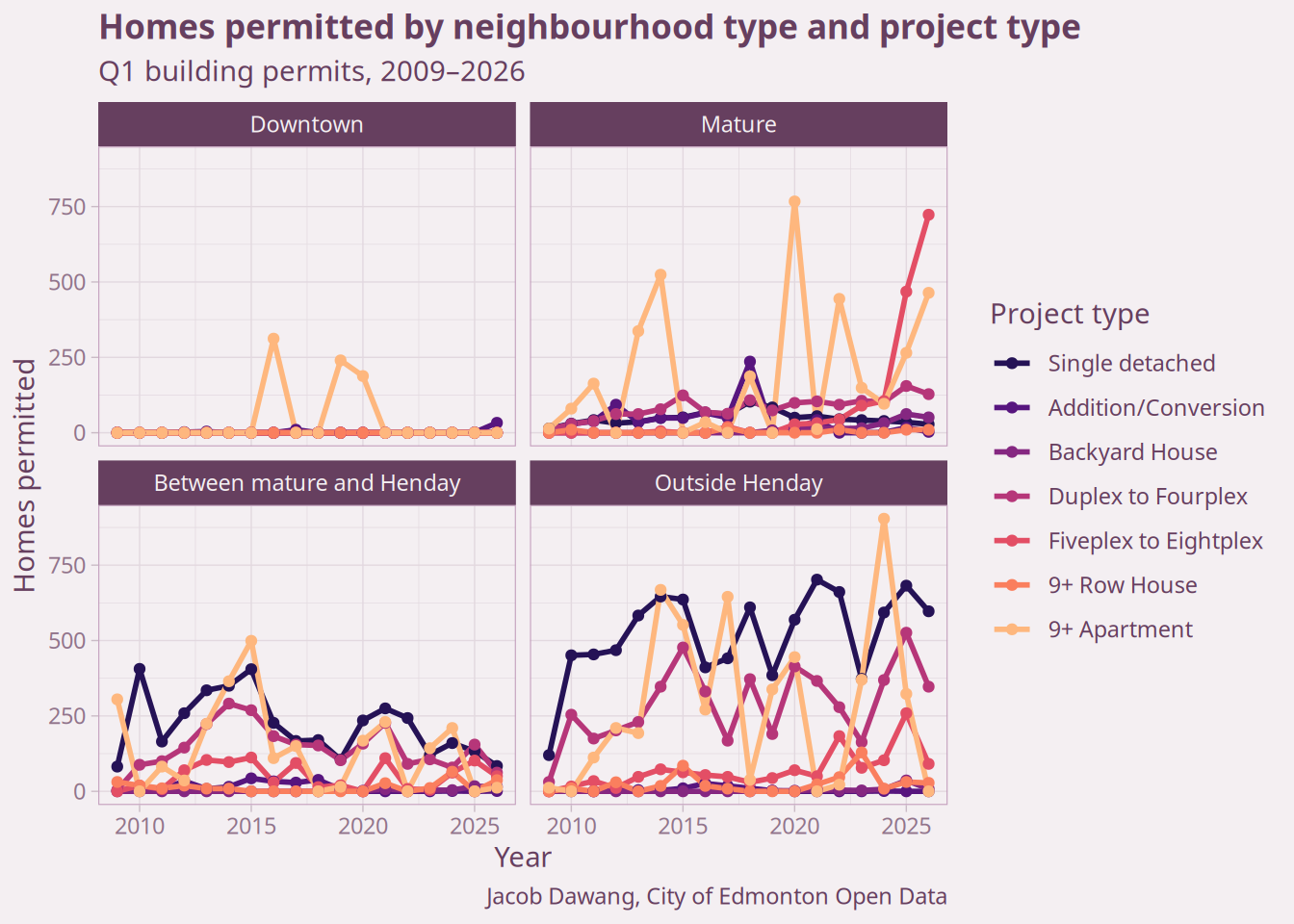
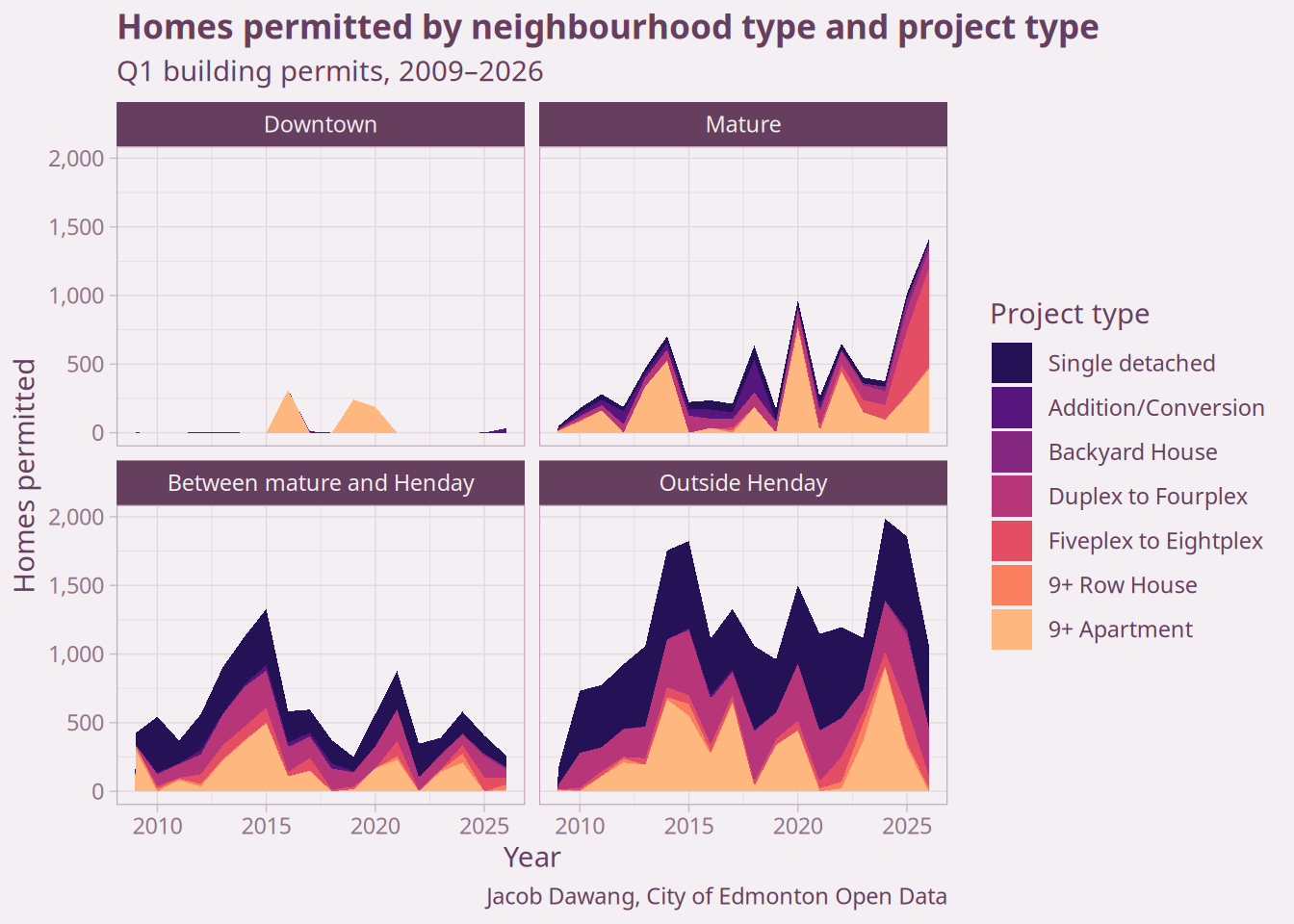
Looking at the number of homes by neighbourhood type, Figure 4 shows continued historical levels of supply in mature neighbourhoods, driven by the 5-8 unit rowhome. Outside the Henday, building permits have gone down in this Q1, though that could be due to the volatility of the large apartment category.
Projecting 2026 from Q1 data
If we take Q1 as an early signal for the full year, Figure 5 shows the historical full-year units added by project type, with 2026 projected from Q1 using the 4.6× adjustment.
We can see a projected dip from the high level of 2025, though 2026 would still be a strong year by historical standards. We’ll have to wait and see, a handful of large apartment projects could significantly move the needle on the total.
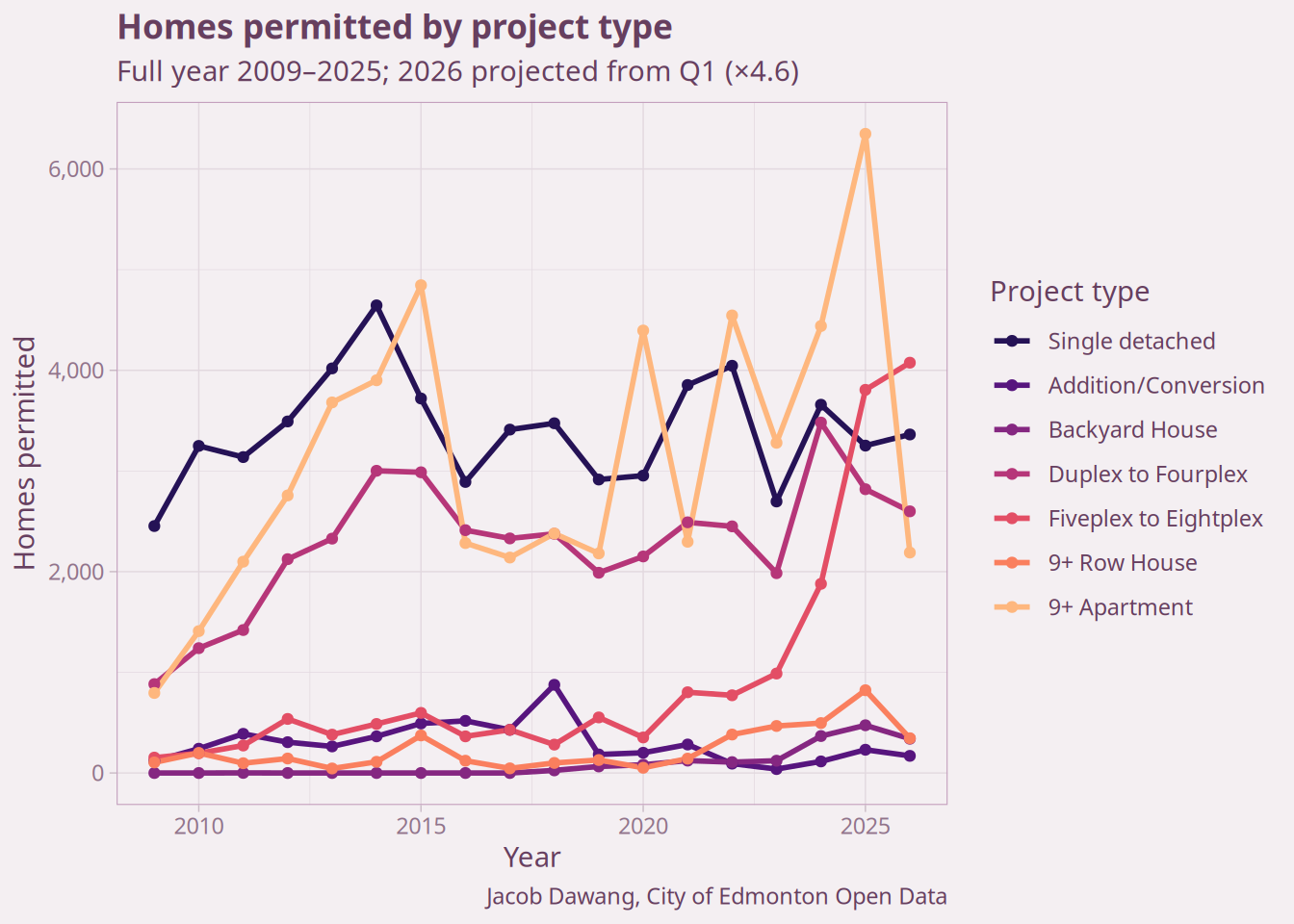
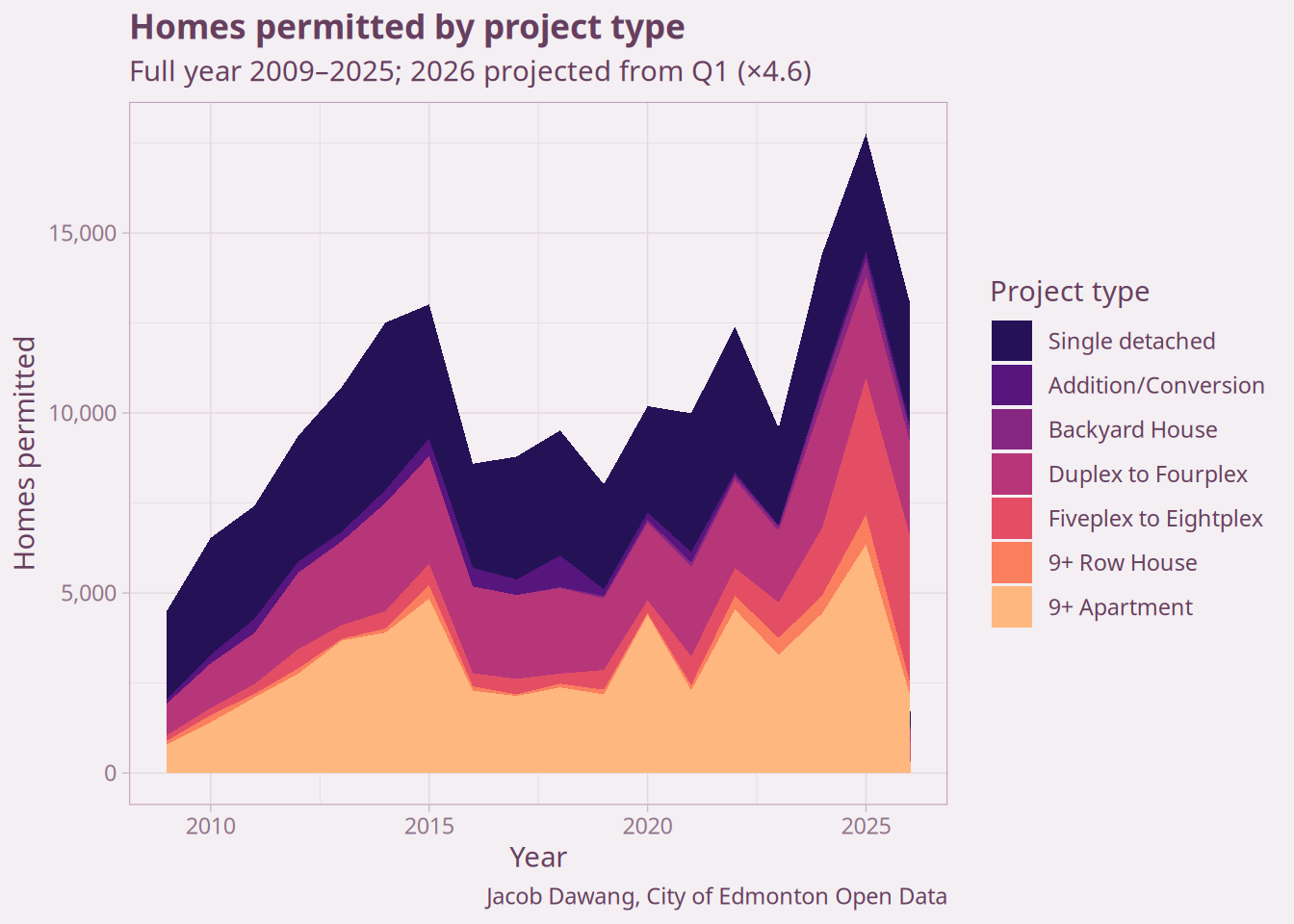
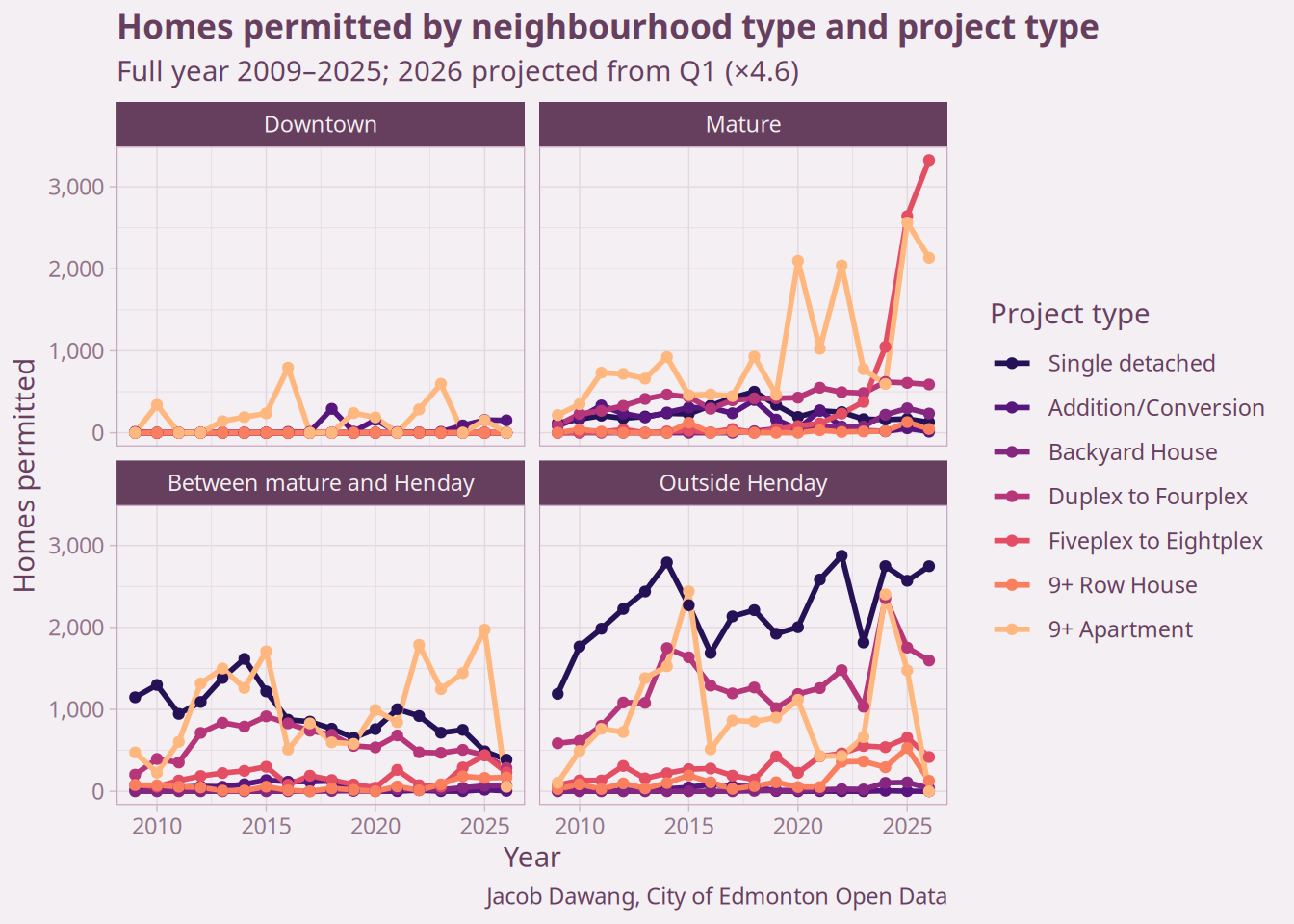
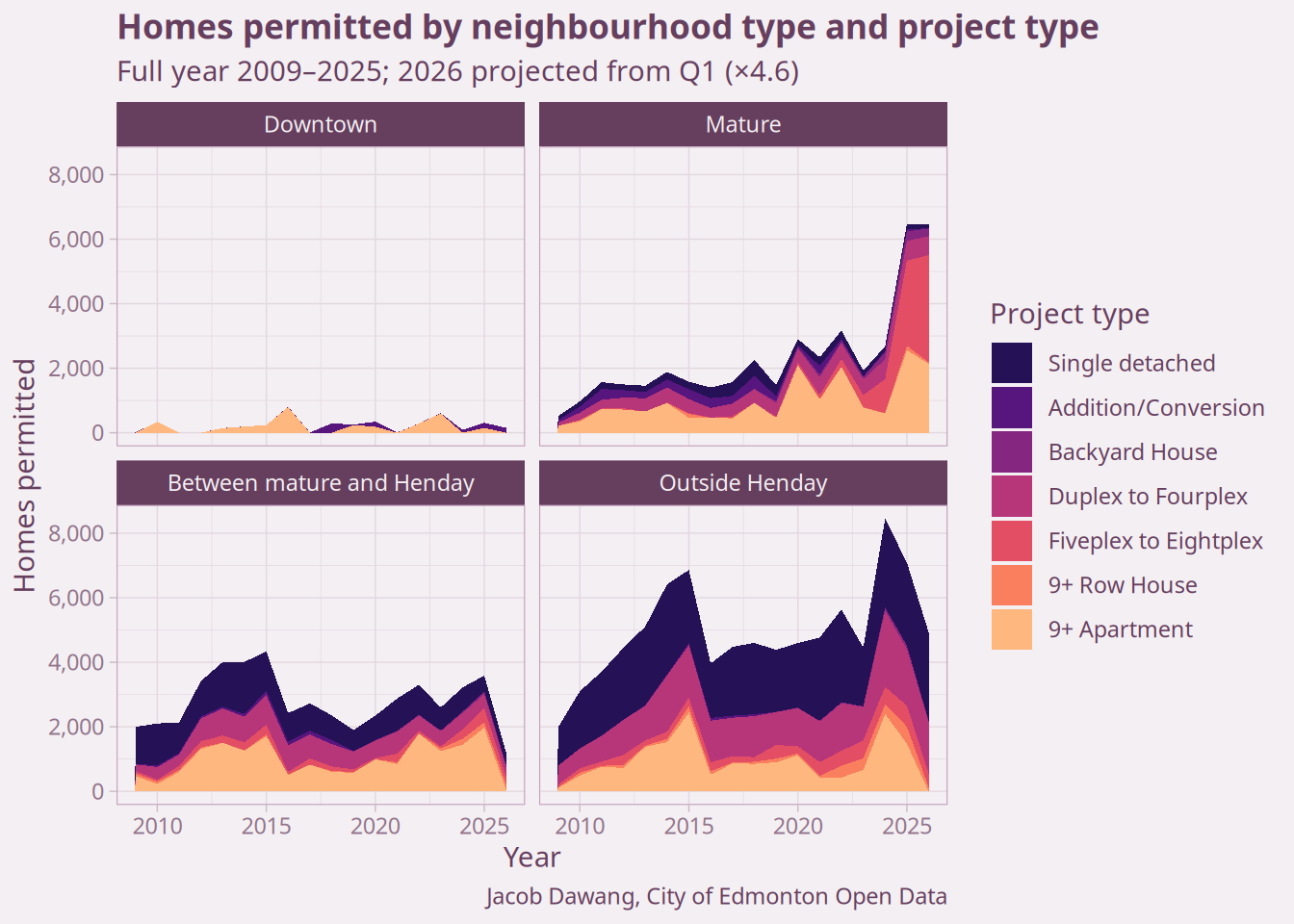
Figure 6 breaks the same projection down by neighbourhood type. We can see that we are projected for another record year in mature neighbourhoods, once again driven by the 5-8 unit rowhome category. 2025 was not a blip: when given the option, a lot of people want to live more centrally, even if it means living in a rowhome instead of a detached house. Why wouldn’t they? They are close to transit, with more mature trees, more businesses within walking distance, and better access to jobs. Many also sit in neighbourhoods with more amenities and room in schools. Moreover, according to a report to Edmonton City Council on February 17, 50% of units in rowhomes are over 1,000 square feet, making them a great option for families. The myth that everyone wants a detached house with a yard in the suburbs should be dead at this point. The rowhome is the new attainable home for Edmontonian families who want to live in mature neighbourhoods, and the data shows that they are choosing it in large numbers when given the option.
Top neighbourhoods for RS infill
Where is the infill actually happening? And how does the level of activity compare to the total number of properties in each neighbourhood?
Table 1 shows the Q1 2026 5–8 unit RS Zone permit activity by neighbourhood type, compared to the total number of RS-zoned properties. Even in Q1, the share of properties being redeveloped is tiny.
| RS Zone intensity by neighbourhood type | |||||||
| Q1 2026, and projected 2026 | |||||||
| Neighbourhood type |
Q1 2026
|
RS-zoned properties |
Projected 2026 (Q1 ×4.6)
|
||||
|---|---|---|---|---|---|---|---|
| Permits | Homes added | % redeveloped | Permits | Homes added | % redeveloped | ||
| Mature | 89 | 667 | 0.11% | 78,551 | 409 | 3,068 | 0.52% |
| Between mature and Henday | 2 | 14 | 0.00% | 64,279 | 9 | 64 | 0.01% |
| Jacob Dawang, City of Edmonton Open Data | |||||||
Table 2 shows the top neighbourhoods by Q1 2026 5–8 unit RS permit volume. These are the neighbourhoods where ZBR’s effects are most visible right now. But even in these neighbourhoods, the proportion of properties being redeveloped is small. This is incremental change, not wholesale transformation, which is exactly what ZBR was designed to enable.
| Top neighbourhoods by Q1 2026 5–8 unit RS permits | |||||||
| Q1 2026 building permits | |||||||
| Neighbourhood | Permits | RS properties | % redeveloped | Homes added | Population 2021 | Population 1971 | Pop. change |
|---|---|---|---|---|---|---|---|
| Glenwood | 7 | 947 | 0.7% | 55 | 4,960 | 5,650 | −12.2% |
| High Park | 7 | 615 | 1.1% | 56 | 1,480 | 2,545 | −41.8% |
| King Edward Park | 6 | 1,456 | 0.4% | 41 | 4,820 | 6,310 | −23.6% |
| Calder | 4 | 1,274 | 0.3% | 30 | 4,455 | 5,325 | −16.3% |
| Holyrood | 4 | 1,081 | 0.4% | 30 | 3,200 | 5,390 | −40.6% |
| Strathearn | 4 | 623 | 0.6% | 28 | 2,445 | 3,410 | −28.3% |
| West Jasper Place | 4 | 567 | 0.7% | 32 | 2,885 | 2,925 | −1.4% |
| Jacob Dawang, City of Edmonton Open Data | |||||||
For comparison, Table 3 shows the same statistics for a hand-picked set of neighbourhoods that have been prominent in debates about RS Zone infill. If one permit for a 5-8 unit rowhome in Q1 would “destroy” the character of neighbourhoods like Crestwood, one would wonder how fragile the character was to begin with.
| Selected neighbourhood 5–8 unit RS profiles | |||||||
| Q1 2026 building permits | |||||||
| Neighbourhood | Permits | RS properties | % redeveloped | Homes added | Population 2021 | Population 1971 | Pop. change |
|---|---|---|---|---|---|---|---|
| Belgravia | 0 | 702 | 0.0% | 0 | 2,220 | 2,940 | −24.5% |
| Britannia Youngstown | 2 | 890 | 0.2% | 16 | 4,350 | 4,590 | −5.2% |
| Crestwood | 1 | 859 | 0.1% | 6 | 2,415 | 3,445 | −29.9% |
| Glenwood | 7 | 947 | 0.7% | 55 | 4,960 | 5,650 | −12.2% |
| Grovenor | 0 | 883 | 0.0% | 0 | 2,585 | 3,100 | −16.6% |
| Mckernan | 1 | 881 | 0.1% | 8 | 2,580 | 2,840 | −9.2% |
| Parkview | 1 | 1,384 | 0.1% | 7 | 3,375 | 5,735 | −41.2% |
| Westmount | 1 | 1,109 | 0.1% | 8 | 6,165 | 7,450 | −17.2% |
| Jacob Dawang, City of Edmonton Open Data | |||||||
Table 4 is an interactive table with cumulative 2024 + 2025 + Q1 2026 activity for all neighbourhoods. You can search for your neighbourhood, or sort by any column.
Cumulative 5–8 unit RS permits by neighbourhood
2024 + 2025 + Q1 2026 building permits
Jacob Dawang, City of Edmonton Open Data
The eight-unit concentration
In 2025, projects with exactly eight units dominated the Fiveplex to Eightplex category in the RS Zone, a direct consequence of the eight-unit cap. Unlike the previous analysis, which focused on 5–8 unit projects, Table 5 covers all RS Zone permits from 1 to 8 units. We can see the most common unit counts are 1, 2, 4, and 8. However, the single biggest driver is the 8 unit rowhomes, providing around half of small-scale homes in mature RS-zoned neighbourhoods.
Given that 8-unit projects account for roughly half the small-scale supply, I continue to be glad that City Council chose not to reduce the number of units permitted to 6. This is an evidence-backed choice that will pay dividends for years to come.
| RS Zone: permits by unit count | ||||
| Q1 2025 vs. Q1 2026 | ||||
| Units per permit | Permits (Q1 2025) | Homes (Q1 2025) | Permits (Q1 2026) | Homes (Q1 2026) |
|---|---|---|---|---|
| 1 | 63 | 63 | 51 | 51 |
| 2 | 33 | 66 | 20 | 40 |
| 3 | 2 | 6 | 2 | 6 |
| 4 | 30 | 120 | 27 | 108 |
| 5 | 0 | 0 | 1 | 5 |
| 6 | 11 | 66 | 13 | 78 |
| 7 | 2 | 14 | 18 | 126 |
| 8 | 40 | 320 | 59 | 472 |
| sum | 181 | 655 | 191 | 886 |
| Jacob Dawang, City of Edmonton Open Data | ||||
Building close to transit
2025 set a record for the proportion of homes permitted within 800m of transit. Is that trend continuing in 2026? Figure 7 compares the cumulative distribution of Q1 homes by distance from the nearest LRT stop, across recent years. Once again, we are on track for a record year for building homes near transit. Within 800m of transit, the cumulative share of homes is 38% in Q1 2026, compared to 30% in 2025. The line for 2026 is above and to the left of the line for 2025, meaning homes are being built overall closer to transit in Q1 2026 than in 2025.
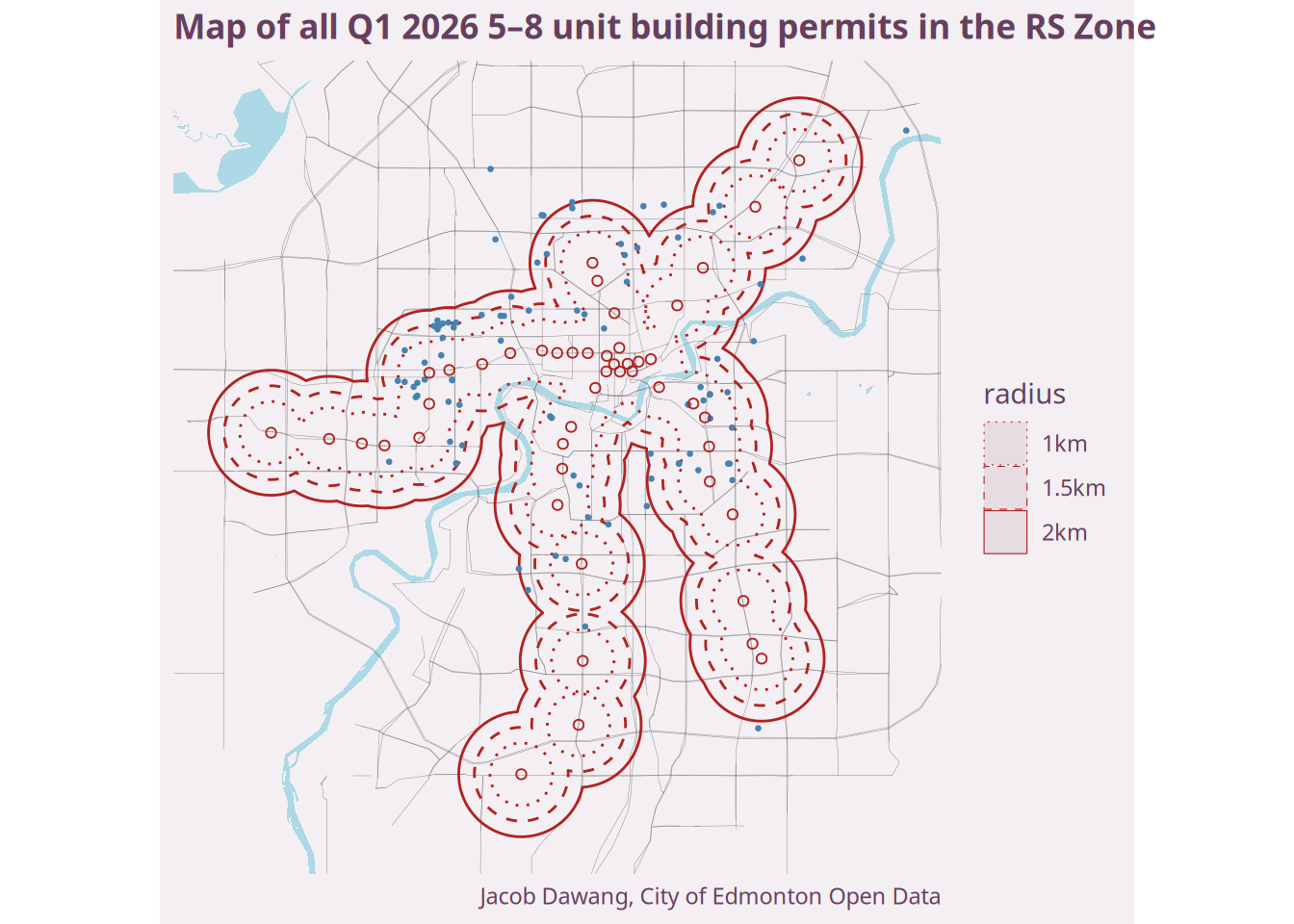
If you are a map kind of person, Figure 8 shows that the 5-8 unit rowhomes continue to trace the path of the LRT.
Conclusions
2026 is shaping up to be another strong year for housing supply in Edmonton. We are building more homes in mature neighbourhoods, more types of homes, more homes near transit, and an overall higher number of homes than historical norms. The RS Zone continues to be a key part of this story, with the 5-8 unit rowhome category leading the way in mature neighbourhoods. The data continues to show that when given the option, people choose to live in more central locations, even if not in a single-detached home.
We’re already seeing the effects of increased housing supply in Edmonton over the past two years. Rents are coming down and landlords are offering incentives. With even more supply on the way, especially in mature neighbourhoods, I am excited about the potential for more affordable, transit-accessible housing options for Edmontonian families in the years to come.
The data continues to make the case for the RS Zone. Every quarter of data at this pace is another argument for keeping, and strengthening, the policies that are producing these results. If you’d like to help advocate for more housing choice in Edmonton, consider joining Grow Together Edmonton.